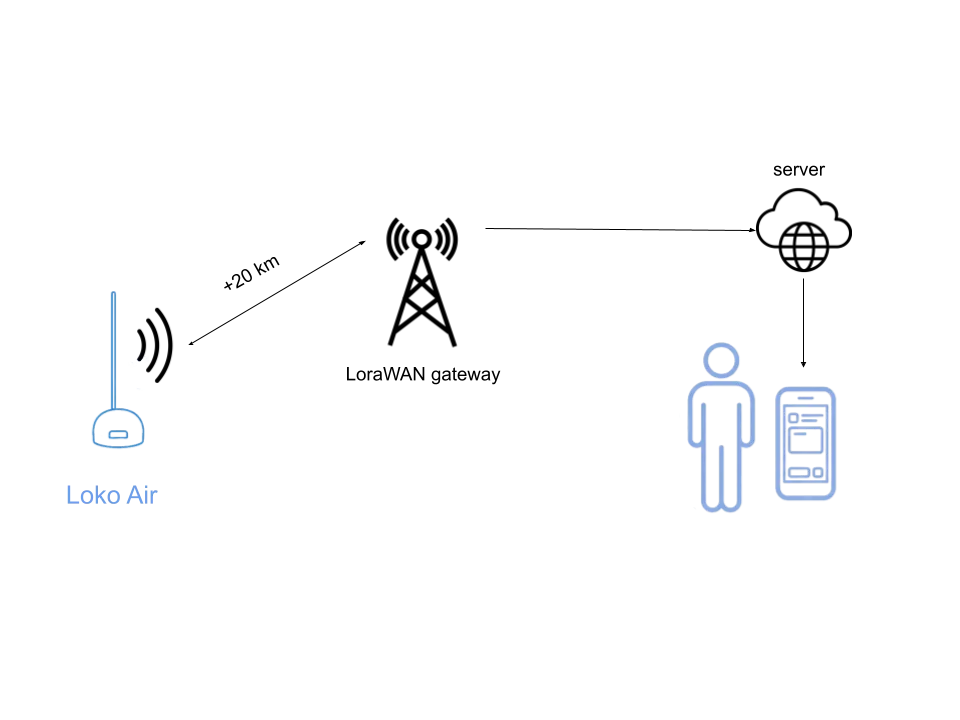
Radio Interface LoRa / LoraWAN. Modulation
LoRa (Long Range) represents a wireless communication technology designed for long-range, low-power, and reliable data transmission with strong interference resistance, making it suitable for IoT applications and low-power wide-area networks.
AM - Amplitude Modulation
FM - Frequency Modulation

Modulation: The process involves encoding information onto a carrier signal by varying its frequency, amplitude, or phase, allowing the transmission of useful signals over a distance.
Amplitude Modulation (AM): The amplitude of the carrier signal is varied in proportion to the information signal while the frequency and phase remain constant.
Frequency Modulation (FM): The frequency of the carrier signal is varied in proportion to the information signal while its amplitude remains constant.
LoRa employs a combined modulation technique based on linear frequency modulation (chirp spread spectrum, CSS), where signal frequency continuously increases or decreases within a defined range.

LoRaWAN modulation utilizes LFM (linear frequency modulation) or CSS (chirp spread spectrum).
LoRa Chirp Modulation: Cycle Breaks & Noise Resistance
Chirp modulation in LoRa consists of irregular cycle breaks, meaning the cycle can stop at any point rather than at equal time intervals. This creates time shifts, enhancing robustness and noise resistance.

LoRaWAN modulation occurs by "breaking" the cycle at intermediate points, interpreted as time shifts.
Radio Interface. Spreading Factor
Spreading Factor (SF): Represents the "speed" of frequency change in LFM signals. Higher SF values indicate slower frequency changes.

Changing the SF by one unit means doubling the cycle (Chirp) time. For SF=7 and 125 kHz bandwidth, the chirp duration is 1.024 milliseconds.
The length of the chirp affects signal noise, enhancing signal recognition at the output. This allows signal detection with lower energy and reduced RSSI levels.


The concept is simplified: Think of SF as a 'zoom lens'—higher SF 'zooms in' for longer range but sends data slower.
Key principle: Higher Spreading Factor = Longer Range but Slower Data.
Data Encoding
Coding: Adding redundant (control) information to the transmitted user data to increase the probability of successful reception.
The level of redundancy is determined by the coderate (CR) ratio, such as 4/5, which means that for every 5 transmitted bits, 4 bits are useful data, and 1 bit is a control (redundant) bit.
LoRaWAN employs Coderate from 4/5 to 4/8.
Data transmission rates (bps) for 125 kHz channel bandwidth depend on Spreading Factor (SF) and CodeRate (CR).

LoRa Signal Sample


The Interdependence of Data Rate and Propagation Distance
The relationship between spreading factor, data rate, and propagation distance is fundamental to LoRa performance. Higher spreading factors enable longer range communication but at the cost of reduced data transmission rates.

Conclusion
LoRa and LoRaWAN technologies provide powerful solutions for long-range, low-power wireless communication. Understanding the key concepts of modulation, spreading factors, and data encoding is essential for optimizing your LoRa deployments and achieving the best balance between range, power consumption, and data throughput.